显示标签为“Workshop”的博文。显示所有博文

2026年10月13日星期二

ClaraView


ClaraView: Private. In-the-Moment. Connected.
(Internal philosophy: "Perceptual augmentation — technology that extends human senses, not replaces human attention.")

ClaraView: 隱私優先的智能眼鏡生態系統

Class: PD2402

Location: A405

Time: Tue. am; Fri. pm


1. Project Overview

- Project Name: 

Clara, from Latin Clarus--bright, clear, transparent--carries a deliberate double meaning in this project. 

Optically, it names what eyewear has always done: render the world clear.

Ethically, it names what this device must do differently, which is to remain clear to its wearer. Here, privacy is not a promise, but a verifiable state. Transparency is not just a technical feature, but also a form of respect.

- Vision statement: 

To develop smart glasses that seamlessly integrate AI capabilities and elevate privacy and scenario-driven ecosystem connectivity.

- Core Objectives:

  • Privacy can be a design constraint that becomes a selling point, not just a compliance checkbox.
  • Deliver a technically robust, comfortable, and stylish AI-powered wearable.
  • Validate product-market fit across target user segments.
  • Establish sustainable business model and ecosystem partnerships.
- Project Duration: 11.3-12.25

2. Workstream Structure

Phase 1: Discovery & Research (Week 9-12)
- Materials
Create a product that is lightweight, durable, and desirable to wear daily.
Frame materials, Lens technology, Battery & power; Sensors integration; Comfort engineering; Sustainability
Deliverables: Material selection matrix

- Core Technology
Build the technical foundation enabling intelligent, context-aware interactions.
Deliverables: Technical architecture document

- Market Research & Competitive Analysis
Understand market landscape, sizing, and positioning opportunities.
Deliverables: Market research report, competitive matrix, pricing strategy brief

- User Research
Ensure product-market fit through deep user understanding.
Persona development (vision/hearing impaired users), User journey mapping
Deliverables: User persona deck, journey maps

- Speech (Week 10-11)
- A Short Report (Week 12)


Phase 2: Concept & Design (W13)
- Scene discovery & Ecosystem Integration
Position glasses as a control hub within broader ecosystems.
Scene discovery workshops
Deliverables: Ecosystem integration roadmap, initial prototypes

Phase 3: Testing and Iteration (W14)
- Usability testing

Phase 4: Marketing Strategy (W15)
- Brand Positioning
Make AI glasses a desirable fashion item, not just a tech gadget.
Deliverables: Brand positioning document

- Business Model
Define sustainable revenue streams and go-to-market strategy.
Deliverables: Business model canvas

Phase 5: Final Presentation (Week16)

3. Case Study: Even G2

G2 demonstrates that doing less (no camera, no complex onboard compute) but doing it reliably, privately, and stylishly can outperform a feature-maximalist approach. 

4. Pillars:

  • Pillar A: Privacy-by-Design

Privacy is no longer a sub-bullet under "Technology"--it is a gating criterion for every feature decision.

  • Pillar B: Scene-Based Design

Scene discovery workshops (user research)

Deliverable: Scene Prioritization Matrix + Scene Journey Maps

  • Pillar C: Ecosystem Embedding (Beyond the Device)

The glasses are the mobile gateway to a broader, secure ecosystem.

  • Pillar D: Perceptual Augmentation

Extending human vision to the invisible: revealing the hidden properties of everyday objects.

Environmental Scenes: water quality, air quality/pollen, UV exposure

Accessibility Scenes: color-blindness aid, low-light vision, sound amplification

Safety Scenes: hazard/structural detection, allergen scanning

Other scenes for inspiration:
- Air quality/pollen index (via data-pull, same as water — low hardware cost)
- UV exposure warning (via data-pull + time/location)
- Color-blindness assistance (software-only, camera-based — but genuinely assistive, not surveillance)
- Low-light vision enhancement (sensor-based)
-Allergen/ingredient scanning (camera + OCR/database — accessibility/health angle)
-Sound amplification for hearing-impaired (microphone-based, no camera needed)

  • Pillar E: Branding with a stylish look

2025年10月14日星期二

The Trivial Matters

The climate and ecological emergency and the covid pandemic have been major factors influencing change in design education, as well as continual economic and political crises. Design education is opening up beyond traditional disciplinary boundaries and becoming less siloed, more trans and interdisciplinary – rather than simply multi-disciplinary.
AI has a significant impact on thinking and practice in all sectors. In Spatial Practices at CSM, we are responding to the challenges of AI positively and experimentally, working with it in collaboration with external industry and research partners, to explore the potential of AI to support advanced thinking and practice around the climate emergency and planetary futures.
"AI has a significant impact on thinking and practice" says CSM's Alex Warnock-Smith

Entitled 'The Trivial Matters: Autonomous Mobility Platform', the project explores how the 'no-man-driving technique' could transform life in urban and rural communities. The mobility platform studies fairly ordinary situations that are thorny and challenging. The project imbues these autonomous hybrid entities with a sense of purpose and significance, aiding in the navigation of challenges such as transportation, food safety, and community relations, thereby mitigating the substantial pressure experienced in contemporary society.

Some background information is provided below:
Revillaging is an international movement towards localized communal living, as a powerful solution to the global metacrises humanity faces. The idea is to reintroduce the sense of community and neighborly practices inherently found in villages (I’m referring to vibrant, thriving villages, not dwindling ones) into urban environments. This approach, coupled with redesigning spaces to cater to the primary needs of city dwellers within walking distance, can effectively tackle mental health issues, housing shortages, and even the climate crisis.
digital nomadism:The first village for digital nomads
Pop-up cities

Keywords:
embedded systems, intertextual world-making

Objectives
Katrina Spade: When I die, recompose me

2) contextualize design practice
energy, society, nature
Futuristic, modular, organic, experimental and always in flux

5) future speculation, story telling
making the invisible visible, new human-object relationships, tackling your worries...
Social Robots at Reichman University
Inside Kyoto University’s self-governed Yoshida Dorm student residence and its radical philosophy
tomorrow-now-when-design-meets-science-fiction

Research
project teams of 1 to 3 students with AI as a partner
encourage bold ideas and view art as a key tool
regular meetings with instructors
build social relationships
ethics and safety

Module 1: social context analysis
Week 09: questions to raise
genuine design innovation: 
layered, improvised, not smooth or logical
to invite exploration, carry memory
participation, people shaping their spaces, bending rules, clashing styles, leaving traces, nourishing human creativity, unpredictability, identity, agency, self-expression
to grow organically over time
Life Inside "THE LINE" - Why Saudi Arabia’s Glass Megacity Will Fail
The Line
homelessness, delivery workers, garbage classification, elderly lifestyles, mental disorders, abandoned mansions, market, breakfast, light meal, children's cafeterias, medical assistance, art activities, museum...
Week 10: community models
atypica.ai

Speech:
Nov.14, 2025 
“自动驾驶如何重塑人机交互”,讲者:范晓宇
“人机共驾 Situation Awareness 和心理负荷”,讲者:杨晔
Nov.21, 2025 “智能技术概要”,讲者:赵佳

Module 2: crafting the speculation
Week 11: data, structure and information
Week 12: proposal presentation

Part 1: new value
1. warm-up exercise: people and space
2. timeline arrangement: prompt design
3. from non-linear thinking to linear thinking to non-linear thinking: anchor points
4. community model building

How do self-driving cars “see”?
Material and Energy Flow Analysis (MEFA)
Week 14: experimenting
Italdesign unveils Climb-E: A unique urban mobility concept at CES 2023
Pixmoving 喻川
Generative Design at PIX
PIX Modular Chassis Platforms With Reconfigurable Wheelbase and Wheel-track
neolix.net 新石器
Why Self-Driving Taxis are a Terrible Idea

Module 4: module growing 
Week 15: testing and iteration
Week 16: final presentation

Part 2: new interactions/skin
1. user - capsule - community 
2. user to capsule: wearables 
3. user in capsule: privacy, trust, security, activities…
4. user in community: business/service model
journey map, storyboard, mood board

Speech: 
Dec.1, 2025 "人机共生时代的交互美学", 讲者:陈辉

Workshop:
Dec.8, 2025 OPPO Wearable Watch Workshop

Final Report:
Dec.25, 2025 
Guests: 武洲,沈亦可,陳春虹,朱令儀。
1. community model building: new value
2. mood board: new skin
3. user - capsule - community: new interactions (wearables, modules, activities)
4. conclusion: ethical thinking for the future

Grading overview
1) 40% of the grade: 
user research (20%), reading and discussions (10%), bi-weekly updates (10%)
2) 60% of the grade:
a high-quality research project: proposal (25%) and final presentations (35%)

2024年11月5日星期二

Underwater Robotics

专题研究1

产品2203

合作方:中电海康无锡科技有限公司

支持单位:无锡市尚贤融创小学

实际项目,用户群为12+青少年。
-藉由PVC水管等各种零件組裝出不同造型的水下机器人,降低套件成本,以利在个人、校园与创客领域推广。
-参与式设计,与青少年合作,探究机器人用户需求和使用场景,完善设计细节。
-提出品牌策略和盈利模式构想。

Problems:
1) Where: pond; swimming pool; bathtub; fish tank...
2) Who: parent-child; teacher-student; student-student...
3) What: nature education; green initiatives, game...
4) When: day; night
5) Why: fun; education...
6) How: journey map

Participatory design workshop:

Workshop1: 
Water Games; Underwater Robot Design Ideas 
Monday, Nov.18, 2024, 11:05am to11:55am 无锡市尚贤融创小学
-icebreaker and grouping (10 mins)
-playful probing games (25 mins): Children's definitions of FUN
-robot imagination (10 mins)

Workshop2: (cancelled)
Monday, Nov.25, 2024, 11:05am to11:55am 
-Science: principle of buoyancy (15 mins)
-Art and Design: modular variations (30 mins)

Workshop3:
Monday, Dec.2, 2024, 11:05am to11:55am
-Science: principle of buoyancy, water resistance (15 mins)
-Art and Design: modular variations and form (30 mins)

Workshop4:
Monday, Dec.9, 2024, 11:05am to11:55am 
--Science: robotics (15 mins)
-Art and Design: concept models (30 mins)
Colour planning
Storyboarding

Dec.12, 2024 Concept Presentation 

Workshop5:
Monday, Dec.16, 2024, 11:05am to11:55am 
-Science, Art and Design: prototype test (30 mins)
-discussion (15 mins)

Dec.19, 2024 Robot prototype test in a pond scenario 

Workshop6:
Monday, Dec.23, 2024, 11:05am to11:55am 
-Haikang underwater robot test (30 mins)
-discussion (15 mins)
Underwater Robot Competition


How Japan Created a Robot-Friendly Future, Today | Momentum

2024年8月14日星期三

蟲

蟲(釋義)
本義是動物的總名,古時包括人在內,都可以“蟲”稱之。
蟲天(百蟲能各自適應所處的環境);
蟲吊(蟲聲。其聲悽切,有如弔問);
蟲出(人死後數日則屍體生蟲。喻死後不得入土安葬)

跨专业设计实践
时长:Week 1-8
班级:产品2101
指导老师:张宪
合作机构:杨柳风人文学堂
支持机构:三零生态系统研究中心

从最日常的虫入手,以艺术、设计与科学,理解和沟通虫的生活世界。

“这就是我理想中的土地,我打算从此跟昆虫彼此亲密无间地生活在这极乐伊甸园内,我的伊甸园就是这个样子。”——法布尔《昆虫记》

一 背景
More-Than-Human Design
is an emerging approach in design that seeks to move beyond human-centric perspectives to include the broader ecosystem of interactions involving humans, other organisms, and the environment.

东郭子问于庄子曰:
「所谓道,恶乎在?」庄子曰:「无所不在。」东郭子曰:「期而后可。」庄子曰:「在蝼蚁。」曰:「何其下邪?」曰:「在稊稗。」曰:「何其愈下邪?」曰:「在瓦甓。」曰:「何其愈甚邪?」曰:「在屎溺。」东郭子不应。
——《庄子·知北游》

This course explores how other-than-human partners inspire us toward other-worldly research methods.
探索非人类如何启发我们不同世界的研究方法。
To generate new questions, processes, and techniques.
催生新的问题、流程和技术。
To propose novel ways of doing research beyond routine academic paradigms.
提出创新的研究方法,超越常规学术范式。

二 讨论
问题一:非人类中心设计是否是仿生设计?
问题二:非人类中心设计是否是生态设计?
问题三:非人类中心设计是否是可持续设计?
问题四:为什么是非人类中心设计?
……
关键概念:
1)昆虫的主体世界 (Umwelt):以昆虫的视角展现出的生活世界。
2)变态发育 (Metamorphosis):神奇的昆虫。
3)生态:从整个生态系统审视昆虫的角色。
4)身体、感官世界:昆虫独特的生存能力。
5)美学:昆虫与人类的关系。
6)伦理:益虫与害虫。

三 内容与方法
1. 回到小时候:大学生跟杨柳风小朋友的互动合作。(3+2) or (2+3)。
2. 资料研读:书籍、电影、纪录片、案例……
3. 访谈:与昆虫达人、自然教育专家的交流讨论。
4. 田野调查:湿地、种植园、博物馆……以我为中心的虫;以虫为中心的生活世界。
5. 装置实验:身体(角色)置换(Life Swap);其它实验设计……
6. 研究范围:
虫(标本、碎片、活物)、養寵、防虫与消杀、环境(家、附近)、生态系统 
可能涉及的领域:动物(昆虫)学、昆虫社会学、生态学、生理学、人类学、动物伦理学、昆虫食物(Entomophagy)……

四 产出

文本、设计(visual communication, comics and animation, product)、装置(robot, prosthesis, wearable system...)、戏剧及其它。


五 时间表
1)Week 1-2 课题介绍、讨论
·破冰游戲設計;
-蟲的畫像1:想象的蟲
-生态系统

2)Week 3-4 分组;田野调查及装置实验
-夜游
-蟲的畫像2: 家蟲
-Q&A rotation game
-Persona(H/I) and Product Definition

3)Week 5-6 文献阅读;设计构思及实验
-Q: Humans and Insects (roles/relationship/future society and future nature)
-蟲疑(虛實真假)
-蟲的畫像3:flipbook (motion)
-Report+Script (地點:楊柳風課堂)

4)Week 7-8 制作、汇报
- script
-章魚課堂
-綫上沙龍
会议提纲:
1)课程介绍(10分钟)
2)嘉宾介绍和各自项目交流(30分钟)
3)话题(60分钟)
(1)人类活动对生态的影响
(2)害虫与益虫
(3)自然循环全生态 vs 技术赋能
(4)安全饮食
4)参与者互动问答(20分钟)

-Movie+Theatre

Insect-Diary

上海昆蟲博物館
南京紫金山昆蟲博物館
昆蟲多樣性監測研究科普基地:無錫大溪港省級濕地公園
瑞士博物學家、科學插畫家 Maria Sibylla Merian
李勝:華南師範大學教授,揭示昆蟲變態發育潛在分子機制。
法布爾《昆蟲記》
安妮 斯韋德魯普-蒂格松《昆蟲的奇妙生活》
有熊谷守一在的地方(2018)
我們由奇跡構成(2018)

川崎聪

Metamorfosis (Franz Kafka - short film)Dragonfly (Short Film | 360° - 3D - Spatial Audio)

Why are cockroaches so hard to kill? - Ameya Gondhalekar

SDGC19 | Matt Ratto: Critical Making as an Antidote to Design ThinkingCómo Hacer un Mini Robot Araña Casero

What If All Insects Disappeared?Women, Evolution and Insects as Food On Reproductive Ecology

《小日常的哲學》代序──小日常與大實踐

2023年9月3日星期日

Ecosystems and Human Health

生態與康養
Ecosystems and Human Health
耕讀小鎮的康養旅居生活

項目所在地:雲南大理州巍山縣南詔鎮小川村
合作單位:北京昌平区多元智能環境研究所 & 大理百川文旅康养有限责任公司
学生:产品2003;公共艺术2002
指导老师:张宪;范晓莉

雲南大理州巍山縣南詔鎮小川村,是南诏第一代王细奴逻的躬耕之地,距今1300多年的历史。小川村所在巍寶山,簡稱巍山,位於巍山縣城東南約10公里處,以南詔國發祥地和道教聖地而出名,是全國13座道教名山之一,山上宮觀眾多,頗為壯觀,山間還建有南詔土主廟,為祭祀歷代南詔詔主而建。
基于以上背景,以及我们的实地调研和访问,耕读小镇的理念可涵盖如下关键词:
耕读/康养/旅居/原住民/原始森林……
最终聚焦到“风土”上,一个深刻洞察文化与自然关系的概念。
此外,需要留意的是,“耕读”主题的生态游,注重原始环境下生成的当地居民与自然环境之间和谐与互生的关系,与道家的生态智慧有共通之处,体现在——
1)见素抱朴:提倡简约、朴素;
2)知足知止:反对过分的旅游消费;
3)物贵天然:反对人为,保持原始生态;
4)道生万物:注重生态的整体和谐;
5)物我两忘:关注精神生态的平衡。

课程包括两个阶段的工作内容:
1)基于传统生态智慧和可持续发展的宗旨,在利益相关者系统分析的基础上,对耕读小镇进行概念规划设计,完成总平面的功能分区布置和风格意象图。
2)融合艺术、设计、科技和自然,创作水循环主题的“无塑”产品设计和艺术装置设计,可结合当地的传统手工艺和非物质文化遗产进行综合应用。

因石油化工行业百年的高速发展,塑料的规模化生产导致的廉价与便利,使得塑料制品深入到人类生活的方方面面。诸如以塑代木、以塑代竹、以塑代纸、以塑代布、金属塑料复合、塑木复合等等,工业设计也因此显得丰富多彩,人们已经习惯于塑料生活的那些美感与体验。所谓过犹不及,如今我们又面临着“碳达峰”“碳中和”的使命,如何减塑净塑,探索非塑料的艺术设计,就是我们面临的挑战。
以“不塑之客”系列产品桌面饮用水设备为例,可尝试应用竹木等天然材料设计具有新价值的产品,以之替代办公室、会议室、茶室的桶装水+饮水机模式,或反渗透+塑料茶吧净水机模式。
户外净水杯市场,由于全塑料制品,以及净水技术选用不当等原因,导致应用受限。“不塑之客”系列产品设计,与保温杯结合,可以进入车载、背包客等更广泛的应用场景,创造替代瓶装水的可能。
类似于云南大理州巍山县需要活化的小川耕读小镇,其山泉水、山体湿地、庭院湿地、村落湿地,思考如何利用雨季积蓄水资源、循环利用生活、生产用水,如何通过简单、顺应自然的净水技术,让居住在这里的人们饮用真正的山泉水,而不再是包装水。如何让看得见的与看不到的水,成为小川耕读乡村的魅力所在。

W1: 課題概述;讲座;分组。
沈亦可: 北京市昌平区多元智能研究所研究员,副所长,三零生态系统研究中心主任, 中国生物多样性保护与绿色发展基金会专家。
什么是三零生态系统?三零生态系统要做些啥事?如何检验这个系统的成败?我们应该喝什么样的水?饮用水市场的一次性消费与全塑化、电气化对人体的危害,对环境的影响,以及对策。
高華:小川耕讀小鎮项目介绍
范晓丽:公共艺术介入耕读小镇
张宪:课题解读与案例分析

W2: 课题解读;市场调研。
刘昕瑜: 北京市昌平区多元智能研究所研究员,三零生态系统研究中心副主任,净水科普馆主编。
内容:塑料以及分类,塑料的降解以及塑料微颗粒污染对人体的危害,对环境的影响,以及对策。
W3:小镇规划概念討論。
W4:小镇规划概念產出(Presentation1)。

W5:场景深化、装置与产品设计討論。
吴强: 北京市昌平区多元智能研究所高级研究员。中国节能协会碳中和专业委员会常务委员,欧盟(EUMN)微纳米技术应用研究院研究员。上海复旦大学智能产业创新研究院特聘专家及创业导师,上海市园林绿化行业协会专家库低碳专家。
内容:碳排放与碳平衡、碳交易,硅钛超材在水净化中的作用。
吴承纬: 北京市昌平区多元智能研究所,高级工程师,净水陶瓷滤膜领域专家。
内容:硅藻土陶瓷滤膜的工业制造与净水原理。
王洪炳: 江苏浦士达活性炭制造有限公司总经理
内容:活性炭的工业制造与净水原理。
吴维奇: 北京市昌平区多元智能研究所,结构设计、执行器技术领域专家,高级工程师。
内容:3D打印技术与生态马桶设计,不锈钢加工技术。
W6:装置与产品设计產出(Presentation2)
W7:模型制作
W8:最终汇报

注:北京市昌平区多元智能环境研究所:
多元智能环境研究所成立于2015年,是由知名生态系统研究学者、专家,生态生活方式践行者、环保公益律师和媒体人组成的民间环保组织。以术载道,研究、推广生态生产与生活融合方式所需的技术和产品,编制相应的规范,建设生态文明社区。及时响应社会公共事件,关注公共利益、推动公众参与、解决公地难题,依据法律框架,利用司法资源,为政府的公共治理建言献策、监督呼吁,从而促进社会可持续发展。

Reference:
WATER is the foundation of PERMACULTURE DESIGN!Rube Goldberg (1940)

2023年5月10日星期三

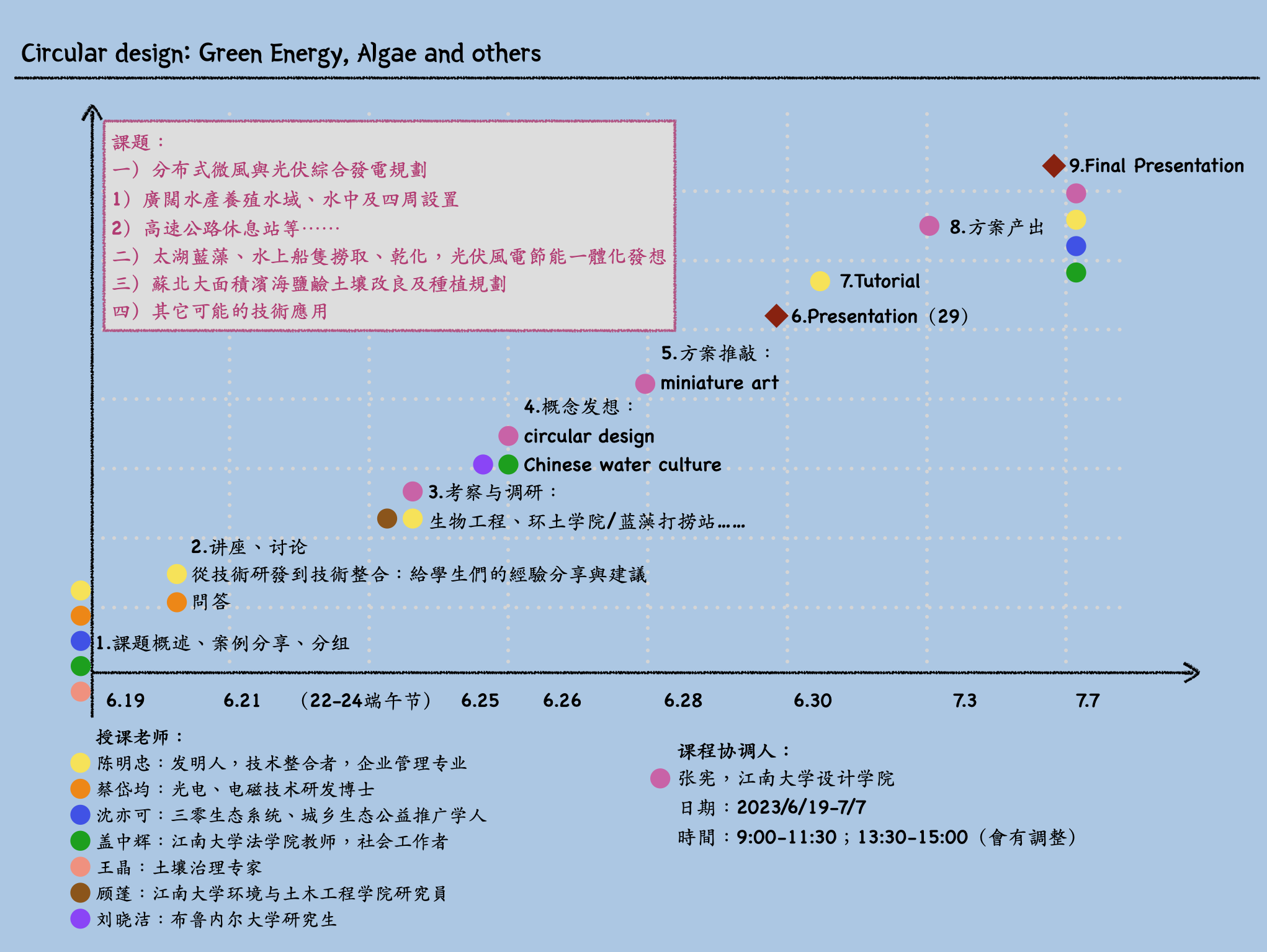
Circular design: Green Energy, Algae and others

Design Workshop
產品2002
W19-21

工作坊課題涉及河流水域的規劃,需要注意技術過於強勢帶來的自然景觀異化,除了文化與美學方面,更表現在人、多物種與河流之間共生關係的失衡。
文明多始於水邊的棲居,近水方便解決灌溉、飲用、排污問題,提供人們生存所需,更有情感與精神上的歸依。因為這種共同記憶,今天我們也願意親近水,觀賞水邊的風景,水邊漫步,露營,健身和遊戲;然而另一方面,水也承受著前所未有的生態壓力,現今普遍應用水工技術消除危險的發生,但可能導致過度的工程,而降低生物多樣性、文化及美學價值,干擾生態系統。
新技術介入下的水治理,從根本上改變了造景邏輯,以無錫太湖水治理為例,用到了雙層圍隔消浪系統、水體透明度提升技術、魚類生態調控技術、沈水植物群落配置技術⋯⋯這些技術配套設施侵入水體,對自然景觀帶來負面影響,有些池塘河流為防控藍藻設置隔離帶,將人與水分離,改變了人與水之間的關係。
(...a fresh and innovative approach to water feature design and construction by exploring the interface and blurring the boundaries between aesthetics, design and engineering.)
課題的目的在於——
探索科技在增强人们对自然的体验和与自然的关系方面的潜力,技术如何有助于丰富人与自然的互动,超越生产力主义或其它功利主义的框架,从而体现其它价值观的重要性,例如快乐、乐趣、关怀或多物种相互关联性,激发围绕技术潜力的对话,以支持未来体验丰富、具有社会文化意义、生态关怀并最终達成令人愉悦的人与自然的纠缠。


可能的課題方向:
一)分布式微風發電規劃
1)廣闊水產養殖水域、水中及四周設置
2)高速公路休息站
二)太湖藍藻、水上船隻撈取、乾化,光伏發電節能一體化發想
1)教育套件
2)美學發現
3)資源轉化與再利用
三)蘇北大面積濱海鹽鹼土壤改良及種植規劃

W19-1: Speech
W19-2: The Seed Phase
(1: strolling)

W20-1: The Experimentation Phase
(2: playing)
W20-2: The Craft Phase
(3: making)

W21-1: The Final Completion Phase
W21-2: (4: showing)

Reference:
The Ellen MacArthur Foundation
circulardesignguide
“Bloomin’ Algae!”
bloom technology
Living Light is an off-grid lamp powered by photosynthesisImagine an Algal World | Matthew Walker | TEDxNewcastleUniversity

2022年4月22日星期五

Life on the Move

Students: PD1901

疫情第三年。
校園封閉至今有月餘,仍無法線下上課。學生們在宿舍上網課,教師分散於校外各自的住所,所在城市亦有一段時間的區域性封閉。總體而言,學生們承受了更大的精神重壓,他們的生活軌跡被限囿於校園之內。
‘Life on the Move’聚焦 Nomadic Design and Lifestyle,特别是帐篷,折叠物经釋放,人與物的關係發生了交替性轉化,這種關係转化的结果是人的去與留,行與止,某種程度上,物成全了人離開的自由,游牧符號亦虛構出想像離開的自由。
帳篷劇導演櫻井大造說,帳篷是“想像力的緊急避難所”,不穩固的帳篷充滿了可能性,帳篷劇是現實與虛構格鬥的場域。他說,今天的人們生活在信息海洋之中,卻是一個無法與過去相遇的時代,人們被未來記憶所支配,個人像是一座座孤島,他思考島嶼之間要如何連接的問題。此次疫情即凸顯出群體互助連接的意義。
‘Life on the Move’ 面對的核心任務是精神的安撫與療癒,除此之外,也關注以下內容:
隱私(Privacy);體面(decency);隨遇而安(Freedom);生存技能(Survival Skills);自然(Nature);可持續(Sustainability);極簡主義(Minimalism and Essentialism);社交(Social Connections)⋯⋯當然這些問題的探討都需要對材料結構,以及物與身體的關係展開試驗。
’Life on the Move’是‘2022 Design Fiction Workshop’的項目,故而該項目面向的是未來的社會與生活。

Schedule:
W11: Briefing/Step1: Mask Tent/Step2: Dorm Life/Tent Research


W12: Step3: Origami-inspired Shelter/Tent Research Presentation


W13: Step4: Plastic Sound
以風或氣塑形,塑料是膜,塑料的聲音也是風的聲音,是人工製品也是自然。
plastic puppet with music; inflatable tent/pillow/mattress
sound; multi senses
function; fun


W14: Step5: Bio-objects, Nomadic design case study
人的物化趋势
social  distancing导致共情困境,人与人沟通的挑战


W15: Step6: Life on the Move, 1:5 Scale Model
“complete the sentence” format; postcard drama(image/text)
W16: Final presentation

The ancient origins of the new nomads

2021年4月19日星期一

The Table(Puppet)

工作坊项目实践
产品1802

偶物质(object puppetry)
"万物皆偶"是迷人的看待世界的视角,回到原初生命状态的最短路径,一种懵懂的对话方式,撞击心灵的交互,纯净精神,抚慰人心。工作坊引入Puppet,并将此元素与身体连接,从偶、偶剧思维训练到偶与身体的互动实验,忽略问题导向及以人为中心的工作习惯,转向偶物质为重心,以及其与身体的戏剧性互动,期翼创造新的感官交互美学。

W10 Speech: About puppet, puppet object and its value to designers
Game1: Breath/trash puppet
W11 Drama Thinking/Back to childhood
Game2: Exchanging childhood memories/paper puppet
W12 Puppet objects with body/human-puppet interaction
Training1: Hand magic/left-right hand interactions

W13 Making a product into a puppet or vice versa
Game3: Object theatre
Three elements: Table/Puppet/Fun
Sketch-Storytelling-Concept
W14 Testing/collecting feedback/improving
W15 Final presentation

Refer:
Object Theatre
Master puppeteer Hobey Ford's magical creations inspire children & adults alike.
The Puppeteer Film with Igor Fokin
Puppeteer Basil Twist at his studio in the West Village - Profiles - The New Yorker
Basil Twist, Stickman and Christopher O'Riley Perform ‘Symphonie Fantasique’ in The Greene Space
Suspension of disbelief through puppetry | Dadi Pudumjee | TEDxIIMIndore
A Portrait of the Puppet Master as a Young ManNatacha BelovaTurning objects into puppets with Lori HopkinsCharlot Lemoine

2020年9月18日星期五

Making Space

1. Background:
科幻小说家威廉·福特·吉布森说,The future is already here, it's just not evenly distributed.(William Gibson)。我们正处在过去现在未来彼此纠缠的年代,未来的降临恐比我们预想得快,我们时常感到措手不及,因而表现出种种纷乱情绪,“Making space”意在探寻不同方式的空间存在,奇异甚或颠倒,或许就是未来的生活形态。

2. Making space for...
                 A home office
                 A garden
                 A cat
                 Minimalist Living
                 Art
                 Culture
                 Business
                 Your inner child
                 Quiet reflection
                 Creativity and hope
                 …
 
3. Schedule
Phase1) Introduction
icebreaker games: 臭味相投

Phase2) Training and brainstorming


Sept. 17. 2020 空间小剧场:左左
喊山(声音)
无实物练习(构筑细节)
空间搭建:购物车(元素)
场景故事:电梯间(气味)/船(运动)
即兴剧:时间/人物/事件/地点

Sept. 29. 2020 金螳螂建筑装饰股份有限公司 郭旭峰

Phase3) Experiments and models

Phase4) Final show
 
Reference:
Jugaad
Deepa Butoliya‘s 'Critial Jugaad' theory
Gary Chang: Life in 32 sqm
石上纯也(Junya Ishigami)
knitknot architecture

2020年4月13日星期一

Sci-Fi Narrative

Background:

Social Distancing, Quarantine, and Isolation
Keep Your Distance to Slow the Spread

Social distancing, also called “physical distancing,” means keeping space between yourself and other people outside of your home. To practice social or physical distancing:
Stay at least 6 feet (2 meters) from other people
Do not gather in groups
Stay out of crowded places and avoid mass gatherings

A Social Distance

Problems & Solutions:

We’re not going back to normal
Social distancing is here to stay for much more than a few weeks. It will upend our way of life, in some ways forever.
To stop coronavirus we will need to radically change almost everything we do: how we work, exercise, socialize, shop, manage our health, educate our kids, take care of family members.
In the short term, this will be hugely damaging to businesses that rely on people coming together in large numbers: restaurants, cafes, bars, nightclubs, gyms, hotels, theaters, cinemas, art galleries, shopping malls, craft fairs, museums, musicians and other performers, sporting venues (and sports teams), conference venues (and conference producers), cruise lines, airlines, public transportation, private schools, day-care centers.

We’re Not Going Back to the Way Life Was Before
Thanks to the coronavirus, the future may arrive earlier than expected.

The best coronavirus quarantine memes: We’re bored to the point of delirium
As we enter day who-the-heck-knows of confinement, people are expressing their on-edge feelings of isolation in creative ways.

Social distancing style
Quarantine Life (cooking/baking/reading/exercising/killing time(puzzles...))
Quarantine memes
Balcony transformation
Remote working
death of the office
E-learning
Virtual dating...
Funeral
Domestic violence
Cultural difference
Mask
Masks are badly designed. Can these startups make better ones—and fast?
Sterilization
Etiquette
Social connections
Coronavirus will also cause a loneliness epidemic
We need to take both social distancing and the “social recession” it will cause seriously.
...

subwaycreatures
lockdown culture 
RCA Artistic Community in Response to Covid-19
get creative

Project:
科幻叙事:瘟疫星球上的理想生活
Design fiction 以及Speculative design皆可以追朔自敘述學(narratology)的影響,例如從科幻小說、電影敘述的啟發,兩者都將「設計物」與「敘述、故事」連結在一起。
Bleecker (2009) 解釋fiction(虛構)是建立在fact(事實)而成的,例如科幻是建立在科普的現實而誕生,設計就是一種綜合科學的、設計的事實與虛構而成,透過設計與敘事的創作,如同科幻小說的力量,讓人們能夠從現實中解脫固有的限制。科幻小說家Bruce Sterling (2005, 2009)同樣解釋,他認為設計師創作出來的設計物,能夠擁有過去、現在以及推測未來的能力,以工業設計師為例,製作一個產品的過程,設計師創造一個物件,不僅需要理解過去到現在的美學、造型、需求的變化,並且推測未來和極大潛力的需求,創造未來(可以是近幾個月、近幾年,甚至是超未來)生活的必需品、新的經驗、新的美學價值。

1 桌面调研
-不同的文化基因
-normal vs. abnormal
-与隐居主义 or 遁世主義相遇
(健身烹饪烘焙园艺宠物农事养生…… )
-社交維繫

2 意象图
我的#COVID19隱居主義(生活域)

3 瘟疫星球上的生活
-找一本科幻或奇幻的书/电影/动漫/游戏(意象)
-背景设定(地铁/公园/办公室/购物中心/居家/餐馆……)
-再造社交故事(工作/感官享乐/游戏/聚会……)

4 材料研究与实验
-材料与设计应用(自然/回收);
食物、植物、旧衣……
-素材九宫格

5 设计传达
-可缩小比例的模型(场景切片-舞台布景)
需要细节,需要形式转化的渐进性。
对不需要的情节避而不谈,对有用的东西则百般重复。

-社交活动(演员及活动)
-以光表现意象(科幻风格)
-摄影/30秒短视频(故事性)

Refer:
Lucy McRae
sixnfive
design fiction
川崎悟司:Japanese Illustrator@satoshikawasaki (How Humans Would Look If We Had Various Animals’ Bone Structures)

2019年7月6日星期六

Making Scents

□□ ✕ 气味

你对什么气味记忆深刻?喜欢又或是厌恶什么气味?
气味从来挑动情绪却又不着痕迹,嗅觉是喚起人类情感记忆最直接及最敏銳的感官。2004年诺贝尔奖得主Richard Axel与Linda Buck发现了嗅觉受体神经如何和气味分子结合进而传导讯息,以及开创了嗅觉受体、嗅觉传导及辨识系統的理论。分布在鼻腔顶端如一片指甲大小的嗅觉上皮,承载约400种嗅觉受体,却具备了能夠辨识超过一万种不同气味的能力。人类「视听味触嗅」五种感觉中只有嗅觉不经过视丘传递,直接將刺激传到大脑中与情感与本能反应相关的腺体。
嗅觉不只是生理现象,也是创造意义的重要来源。文化史学家Constance Classen与人类学家David Howes所编的《香气》一书中,曾提到香气在仪式中的重要性,在他们看來,香气一但被闻到,便会帶來「跨界」或是「范畴改变」的效力,我们都能在香气的引导下,进入他界,一个和日常生活世界不同的领域。
马塞尔·杜尚被认为是嗅觉艺术的最早践行者之一,他将关于嗅觉的探讨直接引向哲学高度,认为嗅觉提供了艺术实践的全新维度。早在100年前的1919年,杜尚的艺术装置《巴黎的空气》(Air de Paris),他将50毫升的巴黎空气压缩在一只安瓿之中,并在上面签名,使之成为一件艺术品。在随后一系列杜尚主导的超现实主义艺术展览中,气味的确得到了运用,嗅觉元素构成了展览表意不可或缺的媒介,与其它装置所提供的视觉经验一起形成多维的艺术欣赏空间。
“□□ ✕ 气味”即是一次旨在释放嗅觉跨界效力的实验,公共艺术与产品设计跨专业合作,更有化学与材料工程学院研究香原料学、应用调香学的储鸿老师助力,以嗅觉与不同领域的载体相结合,此次嗅觉艺术与设计的课程训练将创作的对话界面聚焦至关乎嗅觉的人的身体感官,研究对象拓展至不可见的气味媒介,可能与神经科学、心理学、医学、化学、社会学等多种学科交叉,产出结果无论是装置、食物饮品、产品直至多种媒体表现都可被接受。

第一周
讲座:嗅觉的科学;香水的历史
讨论:喜欢的气味;讨厌的气味(9.12)

第二周
讲座:作为不可见的嗅觉的语言
练习:我的气味以及如何体验的问题(9.20)
气味来源(身体、化妆品、自然、药物、食物);气味状态(喷雾、膏、液);承载物(气囊、多孔吸味材料)
思考:嗅觉的私密性与尴尬;沟通气味的陌生方式;强势的视觉和被干扰的嗅觉

第三周
工作坊:
1)嗅觉房间
规划一个嗅觉体验空间,几位同学几个房间,考虑整体动线的基础上各自设想房间的嗅觉体验概念。
目的在于小组成员的有效沟通,推进概念生成,概念生成初始就将用户(体验者)置于核心位置。
宗教;人的一生;空间转换;气味代码;摆脱原生家庭的悲剧故事;心理探求;过去现在未来的气味体验;喜怒哀惧的气味;妖精的厨房糖果的味道;旅行娱乐;城市食物
2)嗅觉玫瑰
基于1)筛选关键词构成嗅觉风玫瑰,以之为结构深化概念。
3)没有嗅觉的嗅觉
通感,不出现气味而让人感觉到气味。
摄影、短片、表演、声音、文字、裝置
4)嗅球
 基于2)从一个视角出发考虑如下可能的问题:
气味容器(材料)/呼吸机关(嗅觉触发方式)/情境故事(通感)/完整信息传递(文本)

第四~六周
概念产出
实验与原型

第七~八周
制作与展览

Reference:
书籍:
(意)伊塔洛·卡尔维诺,《美洲豹阳光下》,译林出版社,2015.8
(美)黛安娜·阿克曼,《 感觉的自然史》,花城出版社,2006.6
(荷)皮埃特·福龙,《气味-秘密的诱惑者》,中国社会科学出版社,2013.5
(英)艾弗里·吉尔伯特,《鼻子知道什么-日常生活中的气味科学》,湖南科学技术出版社,2013.7
(德)奧利弗‧米特巴赫,《香水之旅-畅游聚斯金德的气味世界》,人民文学出版社,2009.7
(德)帕·聚斯金德,《香水-一个谋杀犯的故事》,上海译文出版社,2005.5
Aroma: The culture history of smell

展览:
“畀自:当代香水设计师展”,上海当代艺术博物馆设计中心psD
contemporary perfumers
Glithero

电影:
香水 

网站:
smell dating

ClaraView

ClaraView : Private. In-the-Moment. Connected. (Internal philosophy: "Perceptual augmentation — technology that extends human senses, n...